Thursday, April 20, 2017

PSALM 4

Hear me when I call upon you,
O God of my vindication,
who supported me
in my anguish.
Have mercy on me
and hear my prayer.

People, how long
will you be foolish?
Why do you love vanity
and follow lies?

But know that the Lord
distinguishes his
devout ones.
The Lord will hear me
when I call upon him.

Tremble, and do not sin,
ponder it in your hearts,
in your beds,
and be silent.
Make offerings
of righteousness,
and trust
in the Lord.

There are many who say,
"Who will show us good things?"
Raise over us the light
of your face, O Lord!
You have given more joy
to my heart
than abundance
of grain and wine.

In peace I will lie down
and sleep,
for you, O Lord,
have made me safe.

Translation © 2015 by Donald C. Traxler


PSALM 3

O Lord, how many they are
who oppress me!
Many rise up
against me.

Many say of me,
"there is no salvation
for him in God."
But you, O Lord,
are my shield,
my glory,
he who lifts
my head high.

My voice cried out
to the Lord,
and he answered me
from his holy mountain.
I lay down, and slept.
I rose again,
for the Lord supports me.
I shall not fear
the myriads of people
arrayed against me.

Rise up, O Lord!
Save me, my God!
For you have struck
the cheek of every
adversary, and broken
the teeth of sinners.

Salvation is the Lord's.
May your blessing
be upon
your people.

Translation © 2015 by Donald C. Traxler


PSALM 2

Why do nations conspire,
and peoples occupy
themselves with vain things?
The kings of the earth
ally themselves
and the princes conspire
against the Lord and
his anointed one.

Let us break their chains,
and cast off from us
their nooses.

The One who lives
in Heaven laughs,
the Lord mocks them.
Then He speaks to
them in his anger,
and in his fury
He terrifies them.

But I was established
King by Him,
on Zion His holy
mountain.

I will declare the decree
of the Lord:

The Lord said to me,
"You are my son,
I have fathered you
this day.
Ask it of me,
and I will give you
the nations
as your heritage,
and the ends of the earth
as your possession."
You shall shepherd them
with an iron staff,
and shatter them
like a potter's jar."

Understand then,
O kings,
be instructed,
O judges
of the earth.
Serve the Lord
in fear, and trembling
rejoice in Him.
Seize upon instruction,
lest He become angered
and you perish from the
way of the just,
in the flash of his wrath.

Happy are all
who take refuge
in Him.

Translation © 2015 by Donald C. Traxler


WHERE IS MERCY?

Donald Traxler · Sunday, October 18, 2015

This morning I had occasion to use a biblical quote. I chose Proverbs 3.3. In the King James Version it goes like this:
“Let not mercy and truth forsake thee . . . “
But I picked up my JPS Tanakh, since it also has the Hebrew original, and read this:
“Let fidelity and steadfastness not leave you . . . “
So I checked the Hebrew:
חסד ואמת אל־יעזבך
It clearly says, “chesed v’emet,” which means “mercy and truth.” I’ve known these Hebrew words for more than fifty years. Why are they now being changed to “fidelity and steadfastness?” When I studied Kabbalah, some fifty years ago, I learned that “Chesed,” the fourth of the ten sephiroth, means “Mercy.” I started to do a little digging.

I found that this change doesn’t only affect Proverbs, but also the Psalms, and in fact the whole Tanakh (what is called the “Old Testament” in Christianity). I’ve previously written about this problem in the Psalms: see my Facebook Note “The Book of Psalms and its Various Translations,” published July 6 2011. Psalm 136 uses the word “chesed” twenty-six times. In every case, it was translated as “ELEOS,” “mercy” in the Septuagint (LXX), made by Jewish scholars in Alexandria in about 200 BCE; in the Vulgate (St. Jerome, ca. 400 CE) as “misericordia,” “mercy;” and in the King James Version (1608 CE) as “mercy.” But now my JPS Tanakh gives it as “steadfastness” and has also changed “truth” to “fidelity.” The Revised Standard Version gives us “loyalty and faithfulness.” What’s wrong with “mercy and truth?”

So I dug a little further, this time in my dictionaries. My dictionary of classical Greek (we don’t have the Hebrew text on which the Septuagint was based) defines “ELEOS” as “pity, mercy.” My dictionary of New Testament Greek defines it as “compassion, mercy.” My Hebrew dictionary (which largely reflects modern usage) gives “grace, favor: righteousness; charity.” In modern Hebrew it is frequently used to mean “charity.” All of this is also consonant with “mercy.” So, if the cream of Jewish scholarship in Alexandria, ca. 200 BCE, took “chesed” to mean “mercy” rather than “steadfastness” and “emet” to mean “truth,” rather than “fidelity,” who are we to change these translations? Is it required by any findings of modern scholarship? I don’t think so.

Here is just one more example, another quote I had occasion to use the other day, Isaiah 59.8:
“. . . they have made their roads crooked, no one who goes in them knows peace.” (Vulgate, KJV, et al are similar.) But my JPS Tanakh says, “They make their courses crooked, no one who walks in them cares for integrity.” I submit that the latter is willful, tendentious mistranslation. the Hebrew clearly says “will not know peace.” I don’t see how it could be any clearer. I know what “shalom” means, and so do you. The Hebrew word for “integrity” is not “shalom,” it’s “shlemut.” They are related words, to be sure, and “shalem” does mean “whole.” But the pointing has been available since about 600 CE and the word was already understood correctly in 200 BCE and 400 CE. Why should we make a ridiculous stretch and try to change it now?

I submit that these are cases of willful, tendentious mistranslation. I believe that this is a trend in modern biblical translations. I believe that this scriptural spinning is done to assuage modern consciences and to avoid offending those in power. If you’d like to see more evidence of this, please refer to my earlier Note, referenced above. God help us if we are in a world where mercy, truth, and peace are out of favor.


Wednesday, April 19, 2017

PSALM 1

Happy are they
who do not follow
the counsel of the wicked,
nor start down the path
of sinners,
nor sit in the seats
of the impudent.

But their joy is in
the law of the Lord,
and on His law they
meditate day and night.

They are like a tree
planted by flowing waters,
that produces fruit in season,
whose leaves do not wither,
and all their works will prosper.

Not so the wicked, not so,
but like chaff blown
by the wind.

Therefore the wicked
will not rise up in judgment,
nor sinners in the
council of the just.

For the Lord knows the way
of the just,
but the path of the wicked
will perish.

Translation © 2015 by Donald C. Traxler


PSALM 9

Note: This psalm is, in the Hebrew text, divided into two psalms: Psalm 9 is comprised of verses 1-21, and verses 22-39 are there called Psalm 10. The psalm, though, is an acrostic (each verse begins with a different letter of the alphabet, in alphabetic order). Two of the verses, those corresponding to the letters Daleth and Samekh, are missing from the Masoretic text, due to its state of conservation, which is poorer than that of the Septuagint. Due to the Masoretic division of this psalm into two, from this point on the psalm numbers in the Masoretic text are one higher than those in the Septuagint and the Vulgate. The numbers again come into alignment with Psalm 148. In my translations the numbers, where they differ, are given according to both numbering systems.

I will celebrate you, O Lord,
with all my heart,
I will tell of all your wonders.
I will rejoice and exult in you,
I will make music to your name,
O Most High.

For my enemies have retreated,
they have fallen down and perished
before your face.

For you have accepted
my judgment and my cause,
you have sat on the throne
as a righteous judge.

You rebuked the nations,
destroyed the wicked,
erased their name forever.

The enemies have vanished,
their acts in eternal ruin,
you have destroyed their cities,
the memory of them has perished.

But the Lord abides forever,
he has established his throne
for judgment, and he will judge
the world with justice,
he will judge the peoples with equity.

The Lord will be a refuge
for the oppressed,
a haven in times of trouble.

They will hope in you
who have known your name,
for you, O Lord,
do not abandon
those who seek you.

Make music to the Lord
who dwells in Zion,
announce his works
to the nations,
for the avenger of blood
has remembered them,
he has not forgotten
the cry of the poor.

Have mercy on me, O Lord,
see the affliction that I suffer
from the hands of my enemies.
Lift me from the gates of death,
that I may proclaim all your praises,
that in the gates of the daughter of Zion
I may rejoice in your deliverance.

The nations have fallen into
the pit that they made,
their foot is caught in
the snare that they hid.
The Lord has shown himself
and given judgment.
The wicked have been caught
in the works of their hands.

Let sinners be turned back to Sheol,
all the nations that have forgotten God.
For the poor will not always be forgotten,
nor the hope of the needy forever lost.

Rise up, O Lord, lest man prevail,
let the nations be judged in your sight.
Set a teacher over them, O Lord,
let the peoples know
that they are only human.

Translation © 2015 by Donald C. Traxler


THE BOOK OF PSALMS AND ITS VARIOUS TRANSLATIONS

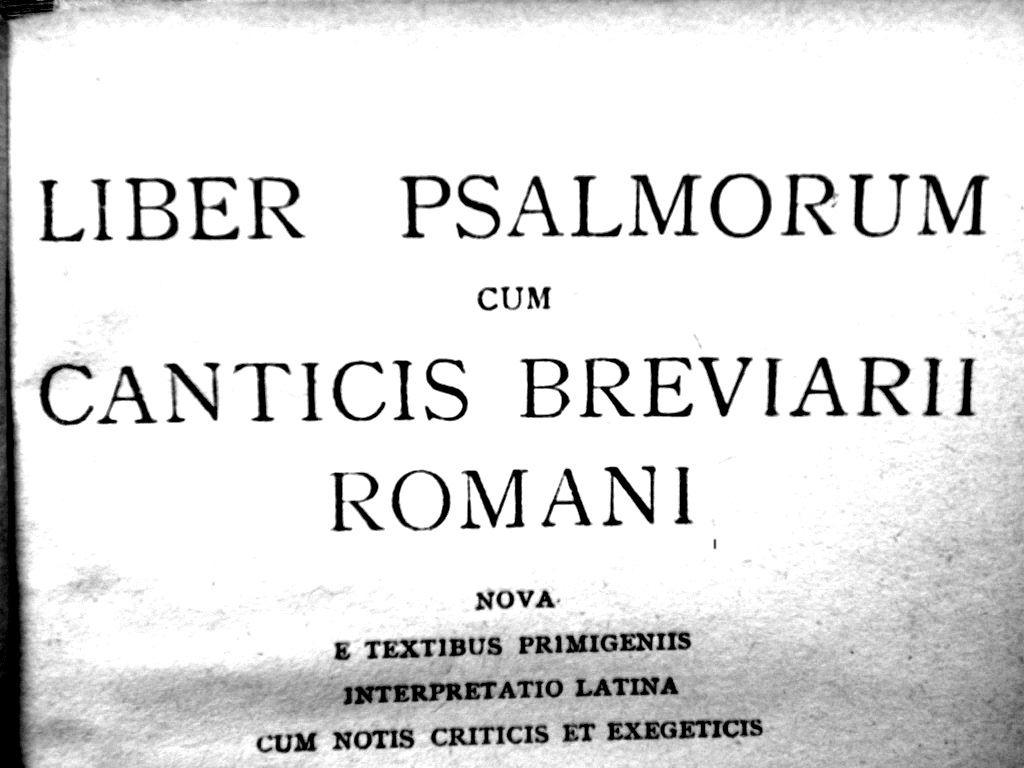
I'm very disappointed. Recently, after not having seen one for many years, I received a copy of Liber Psalmorum cum Canticis Breviarii Romani. It is the 1944-45 translation of the Psalms by the Pontifical Biblical Institute, ordered by Pius XII.

I expected a lot of it, because I agree with its announced premise: that the best text of the Psalms is the Hebrew text that underlies the Septuagint. Unfortunately, that Hebrew text no longer exists, and they have supposedly tried to reconstruct it. I cannot speak to their methods, but I'd like to say a few things about the results.

One expects a lot from a group calling itself the Pontifical Biblical Institute, so this translation has been very influential. In fact, the Book of Psalms in every Catholic translation of the Bible since the Second World War has been based on it. Due, I suppose, to the soundness of its basic premise, it has also strongly influenced modern Protestant translations, such as the NRSV and the NIV. All of this is extremely unfortunate.

This Liber Psalmorum, or New Latin Psalter (I'll refer to it as NLP from here on) has so far failed every test to which I have put it.

Recently I've noticed that modern translations of the Book of Psalms are tendentious in that they water down the original, strong language of the Psalms. The effect of this is to make the Psalms less of an indictment of the human social order, and to make them less embarrassing and threatening both to the civil governments of the world and to the institutional Church. I'll give some examples.

In Psalm 5, v. 12, the Vulgate has the phrase "et habitabis in eis," "and you will live in them." The verb used in the Septuagint (LXX) is "kataskEnaO," which means "to take up one's quarters, to pitch a tent, to encamp." But the NLP and its followers have "and protect them," certainly a less intimate relationship.

In Psalm 8, v. 5, the Vulgate, accurately reflecting the LXX, which is our rock, our compass, has the phrase "aut filius hominis, quoniam visitas eum," "or the son of man, that you visit him." But the NLP and its followers have "that you care for him." Now that Greek word has both of those meanings, so both interpretations are possible. But the Vulgate translated the word literally, suggesting a more intimate and direct relationship with God, something the institutional Church has always found threatening. By itself, I wouldn't say much about it, but it is part of an unfortunate pattern. The Hebrew word, by the way, doesn't have that ambiguity: it simply means "to visit."

I should take a little detour here, and say something about our beloved King James Version, of 1608. It contains, in my opinion, the last honest translation of the Book of Psalms. Where it differs from the Vulgate and the LXX, it is usually because something (often a whole verse) is missing from the Masoretic Hebrew, upon which it is based. For example, it leaves out the "NUN" verse that should be in Psalm 145, an alphabetic acrostic. But the omission had no agenda; it simply reflected the poor state of the Masoretic text.

Another example of the watering-down process is seen in Psalm 9b (10), where the Greek and (St. Jerome's) Latin tell us that while the impious man fills himself with pride, the poor man "goes up in flames." But according to the NLP, the poor man "is vexed." The Hebrew word in the Masoretic text means "to burn."

Our last example, for present purposes, comes from Psalm 11 (Vulg. and LXX)/Psalm 12 (Hebrew and KJV), where we find (in the Vulgate, which is basically a faithful reflection of the LXX) the phrase "Propter miseriam inopum, et gemitum pauperum. . ." This can be translated as "Because of the misery of the needy and the groans of the poor. . . " The LXX  has "Because of the misery of beggars and the groaning of the poor. . . " But in the NLP, the "misery of beggars" becomes "the affliction of the lowly" (afflictionem humilium).

Yes, let's forget that there are beggars, and let's reduce their "misery" to "affliction," which makes it all more abstract. Let's not offend the governments of the world, or the billionaires who own and control them.

In Florida and some other states, it is now illegal to feed the homeless or their children, and those who try to do it are arrested. To feed them is, of course, to notice them, and to admit that they exist.

All of this does not just "vex" me; it burns me up.

© 2011-2015 by Donald C. Traxler