Friday, April 22, 2022

My Return to Film Photography - XIX


I am still focused (so to speak) on infrared, and I bought a 6-in-1 adjustable Fotga filter (range 530-750nm) to further explore the Rollei Infrared 400 film. What I have learned is that the film's sensitivity drops off significantly beyond 710nm. The photo above was shot with the filter set to 530nm, and shows the typical IR "woods effect," with dark (sometimes black) sky and glowing, white leaves. The 530nm setting was never problematic in these tests: the filter factor and the results appear to be about the same as with my Hoya 25A (deep red) filter.


The photo above is a more moderate editing, and was also shot with the filter set to 530nm.


This photo was shot with the filter set to 620nm. The IR effect is a bit more pronounced. The only problem is that it is slightly underexposed. My method in these tests was to set a slow shutter speed and let the camera set the aperture. The first photo was shot at 1/30 sec and f16: this one was shot at 1/30 and f5.6. But I was using a lens with a maximum aperture of f1.4. I judge the negative to be underexposed by one stop. Why didn't the camera select a wider aperture? What is happening here is that the film's sensitivity to infrared light is lagging behind that of the camera's internal CdS metering system. The correct exposure would be 1/30 at f4 for EV7 outdoor sunlight. That's an easy adjustment to make, and the time is still practical, so 620nm is quite usable. I like the effect, and I intend to use it a lot.


The photo above was shot with the filter set to 710nm, It is more underexposed than the preceding one, which accounts for the loss of shadow detail. It was shot at 1/30 at f4, which should have been 1/30 at f2, a two-stop difference. If this is kept in mind, the 710nm setting is usable.


The photo above was shot with the filter set to 720nm, a setting that I regard as marginal for this film. It was shot at 1/8 sec at f2 for EV5 artificial light (mostly quartz-halogen), and I consider the negative to be underexposed by three stops. In other words, the exposure really should have been 1/2 sec at f1.4, which is not really practical

Rollei's technical information and marketing site, www.maco-photo.de, recommends a filter in the range 715-750nm, which I think is gilding the lily. The drop-off in IR sensitivity beyond 710nm is a definite problem for practical purposes, though it would be less severe if one were to use this film only in sunlight. I made a rough, non-isometric graph to illustrate this:


My estimated projection of the graph for 750nm (here cut off) was 8 sec at f 1.4! It's only a rough approximation, but it gives an idea of the problem.

Now that I have some approximate exposure benchmarks, I feel a need to test them. I only have one roll of IR film in my current stock, and it happens to be 120, so my next tests will be done on the Mamiya C33. That will also give me an opportunity to test my new (to me) 65mm lens. Meanwhile, shoot film, if you can!

(to be continued)


Text and images Copyright © 2022 by Donald C. Traxler aka Donald Jacobson Traxler.


Tuesday, April 19, 2022

Doubt Many Things / ᎤᏝᏏᏚ ᎤᎪᏗᏗ ᎢᏳᏍᏗᏗᏁ


Ꭴ⁠Ꮭ⁠Ꮟ⁠Ꮪ⁠ ⁠Ꭴ⁠Ꭺ⁠Ꮧ⁠Ꮧ⁠ ⁠Ꭲ⁠Ᏻ⁠Ꮝ⁠Ꮧ⁠ᏗᏁ⁠,⁠ 

⁠Ꭰ⁠Ꮞ⁠Ꮓ⁠ ⁠Ꭴ⁠Ꮼ⁠Ꭿ⁠Ᏻ⁠Ꭴ⁠ ⁠Ꭺ⁠Ꮁ⁠Ꮝ⁠Ꮧ⁠Ꮑ⁠.


U⁠tla⁠si⁠du⁠ ⁠u⁠go⁠di⁠di⁠ ⁠i⁠yu⁠s⁠di⁠di⁠ne⁠,⁠ 

⁠a⁠se⁠no⁠ ⁠u⁠wo⁠hi⁠yu⁠u⁠ ⁠go⁠hu⁠s⁠di⁠ne⁠.


Doubt many things,

but believe something.


Text and image Copyright © 2022 by Donald C. Traxler aka Donald Jacobson Traxler, ꮓꮘꮟ-ꭴꭶꮤ.


Sunday, April 17, 2022

The Day Is Always Better / ᎢᎦ ᏂᎪᎯᎸᎢ ᎤᏟ-ᎢᏲᏍᏛ


Text and image Copyright © 2022 by Donald C. Traxler aka Donald Jacobson Traxler, ꮓꮘꮟ-ꭴꭶꮤ.


Saturday, April 16, 2022

The Camera Is My Voice / ᏗᏓᏟᎶᏍᏙᏗ ᎨᏒᎠᏎ ᎠᏆ ᎧᏁᎬ-ᎤᏃᏴᎬ


Text and image Copyright © 2022 by Donald C. Traxler aka Donald Jacobson Traxler, ꮓꮘꮟ-ꭴꭶꮤ.


Tribute to Francesca


Text and image Copyright © 2022 by Donald C. Traxler aka Donald Jacobson Traxler.


Tuesday, April 12, 2022

My Return to Film Photography - XVIII


In this instalment of our series, I'm going to be writing about infrared photography, film, and filters, with special attention to the so-called "x-ray vision effect." X-rays, of course, are a whole different thing: those frequencies are above UV, which is itself above the visible-light spectrum. Infrared (IR), on the other hand, lives below visible light. Below infrared, you find heat and radio waves.

Because infrared frequency numbers are quite huge, it has been found convenient to specify their wavelength instead. For example, the infrared filter that I recently bought passes a certain spectrum of IR wavelengths, but especially 850 nm (nanometers). I bought it for a specific purpose: to test the IR "x-ray vision effect," having learned in my research that that is the wavelength where the effect works best.

I did many tests with the new filter, testing various fabrics: cotton, polyester, nylon. rayon, spandex, and so on. Much to my surprise, all of these tests came out blank: no image. The reason, as I now know, is simple: the sensitivity of Rollei IR 400 film does not extend to 850 nm. Perhaps that is why my new filter is not among those listed by Rollei as recommended: B + W RG665 / 090 /091 /092 / Heliopan RG645 / RG695 / RG715 / Hoya 25A / Kodak Wratten 25 / 29 / 89B / Lee 25 / Rodenstock 25.

Now I assume that numbers such as 645, 695, and 715 represent nanometer (nm) numbers. For this special effect, the closer we can get to 850, the better. But the highest number recommended for this film is 715. I've seen a lot of filters advertised for 720 nm, which should  be close enough, so I'll probably get one of those.

By the way, my new filter says "digital" right on it. The thing is, all photocells inherently have better IR sensitivity than any readily-available film (but in cameras, most are equipped with an IR-blocking filter). That is why the TTL exposure metering in my Canon AE-1 showed a usable amount of 850nm light, although the film itself was not sensitive to it.

So most of my 36 exposures of IR film showed no image, But all is not lost. Fortunately, I shot the last eight exposures with my old, tried and true (and recommended) Hoya 25A filter. I got eight perfect exposures.

Those eight exposures, having been shot at a less-than-ideal IR wavelength, showed little, if any, "x-ray vision effect." I had a feeling, though, that I might be able to bring out the effect a bit more by playing with contrast and brightness. And so it was. I was even able to determine the relative transparency to IR of various fabrics. Here are a few images, for the sake of illustration:


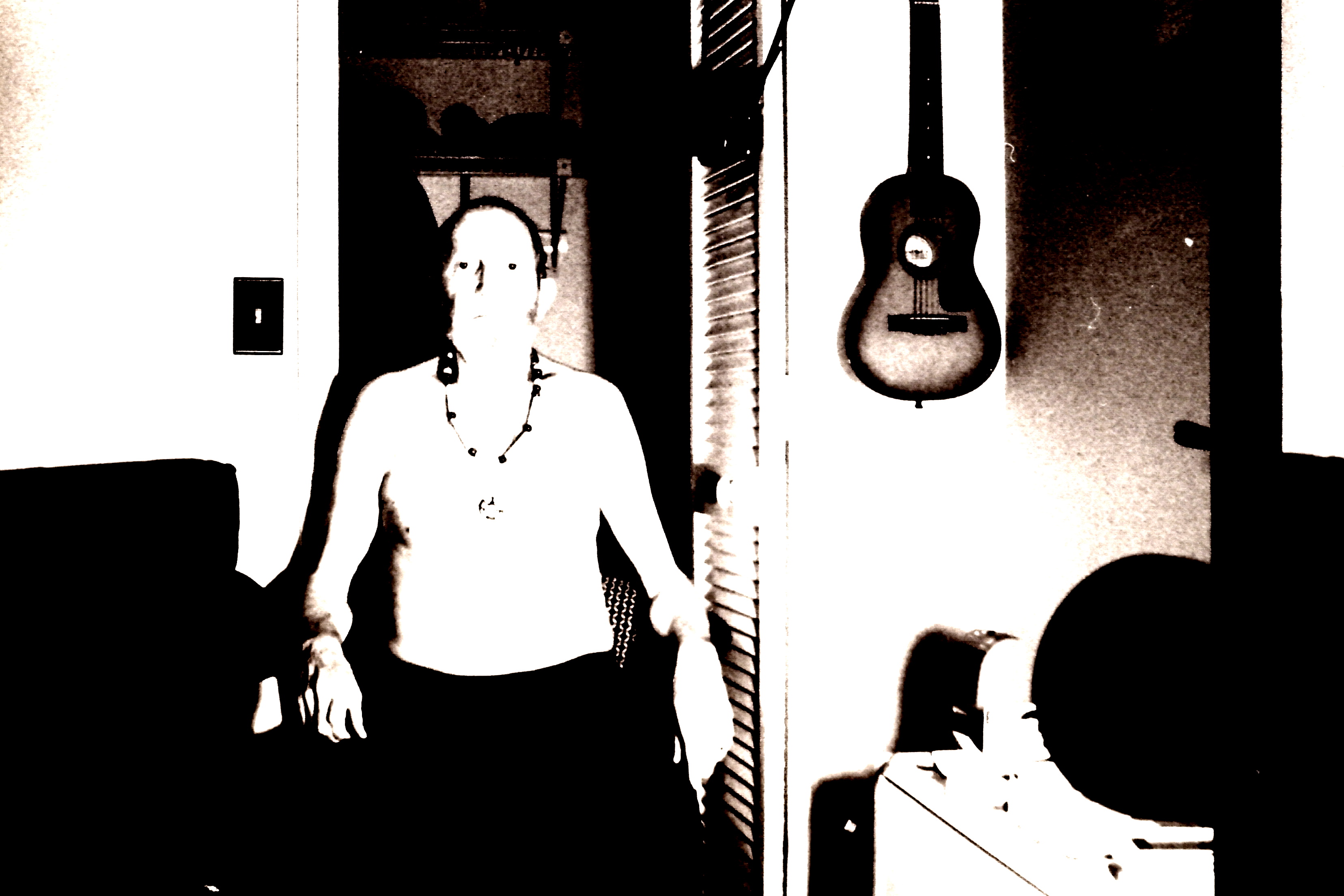
In general, I found Nylon to be best for the "x-ray vision" special effect. I am especially impressed because this Speedo (74% Nylon, 26% Spandex) also has a liner in the middle part, which is 86% Nylon and 14% Spandex. To the extent that it's transparent, it's transparent through two layers.


These baggy, loose-fitting shorts are 100% Nylon.


This black sarong is 100% Rayon.


I wondered whether the same effect might be achieved with a non-IR image, just by fiddling with the contrast and brightness. The photo below is digital, shot in ordinary, visible light:


This is the same Nylon sarong. Nope, no transparency.


The photo below was shot on film. Same sarong.


Nope, no transparency in ordinary, visible light, even with adjustments to contrast and brightness.

It will be interesting to see how a 720 nm filter and IR film works out.


(To be continued) 

In the meantime, shoot film, if you can!


Text and images Copyright © 2022 by Donald C. Traxler aka Donald Jacobson Traxler.