We do not see the whole person.
Only the spirit can do that.
ᎢᏧᎳ Ꮭ ᎪᏩᏔᏎ ᎧᎵᏬᎯ ᏏᏴᏫᏁ.
ᎤᏩᏌ ᎠᏓᏅᏙ ᏰᎵᏆᏎ ᎿᏛᎩ ᎾᏍᎩᏁ.
Text and image © 2019 by Donald C. Traxler ꮨᏺꭽꮅ.
Saturday, July 6, 2019
Body and Spirit / ᎠᏰᎸ ᎠᎴ ᎠᏓᏅᏙ
Body and spirit
are the two hemispheres
of our life.
We show one
and hide the other,
or we hide both.
Why?
ᎠᏰᎸ ᎠᎴ ᎠᏓᏅᏙ
ᎨᏒᎠᏎ ᏔᎵ ᎠᏰᎵ-ᎢᏴᏗ
ᎠᏆᏤᎵ ᎥᎴᏂᏙᎲ ᎥᎿᎢ.
ᎢᏧᎳ ᎤᎾᏛᏁᎸᏓᏎ ᏌᏊᏁ
ᎠᎴ ᎠᏗᏍᎦᎶᏓᏎ ᏐᎢᏁ,
ᎠᎴ ᎢᏧᎳ ᎠᏗᏍᎦᎶᏓᏎᎢᎬᎳᏁ.
ᎦᏙᏃ?
Text and image © 2019 by Donald C. Traxler ꮨᏺꭽꮅ.
are the two hemispheres
of our life.
We show one
and hide the other,
or we hide both.
Why?
ᎠᏰᎸ ᎠᎴ ᎠᏓᏅᏙ
ᎨᏒᎠᏎ ᏔᎵ ᎠᏰᎵ-ᎢᏴᏗ
ᎠᏆᏤᎵ ᎥᎴᏂᏙᎲ ᎥᎿᎢ.
ᎢᏧᎳ ᎤᎾᏛᏁᎸᏓᏎ ᏌᏊᏁ
ᎠᎴ ᎠᏗᏍᎦᎶᏓᏎ ᏐᎢᏁ,
ᎠᎴ ᎢᏧᎳ ᎠᏗᏍᎦᎶᏓᏎᎢᎬᎳᏁ.
ᎦᏙᏃ?
Text and image © 2019 by Donald C. Traxler ꮨᏺꭽꮅ.
Friday, July 5, 2019
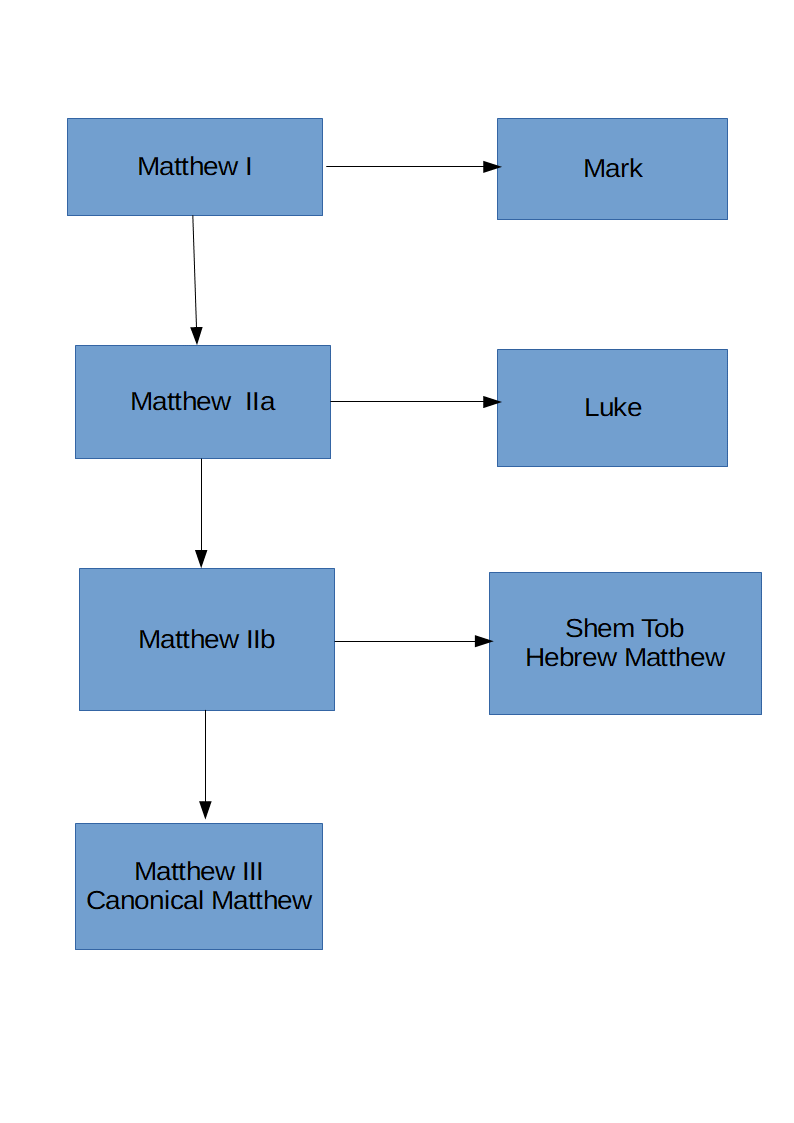
Synoptica VII - Omissions and Interpolations, and What They Can Tell Us
All of "Luke's Great Omission" (corresponding to Mark 6:45-8:26) is essentially present in Hebrew Matthew (my Matthew IIb) Some of this material stretches credulity, but Luke included a lot of other stories that do the same. Some of it could be offensive to Gentiles, his main readership, but a slight rewording would have been sufficient. It really doesn't make sense that Luke would have omitted this material unless HE NEVER SAW IT. I believe that this material, called Luke's "Great Omission" by Markan Prioritists," is actually an early interpolation, but one later than the "Matthew IIa" that Luke made use of.
The Walking on Water incident is part of this early interpolation, and is included in Hebrew Matthew, and most of it is in Mark. But the part where Peter walks on water too (Mt.14:28-31) is not in Mark. Perhaps it is a later interpolation.
The words about the "leaven of the Pharisees and Sadducees" (canonical Mt. 16:6-8a) are missing in Hebrew Matthew (my Matthew IIb). Although these words have parallels in both Luke and Mark, this omission is a "Western" (early text) omission in the Greek tradition. It may, therefore, be a very late interpolation into the canonical Synoptic Gospels Its purpose is not obvious, but it may simply be anti-Semitic or anti-Judaistic. At any rate, it does sound like an interpolation, and is not at all necessary to the flow of the narrative.
The presence or absence of even a single word can be extremely interesting. For example, canonical Mt. 14:34 includes the place-name "Genessareth," which also appears in Mk. 6:53, but it is absent from the Hebrew Matthew of Shem-Tob, which I assign to the Matthew IIb layer of the Gospel of Mathew. At first I thought that this variant was insignificant, but it now seems to me to be very significant. It cannot have been left out of the Shem-Tob Matthew for any polemical reason, so I suspect that the inclusion of the place-name is a late interpolation, done to increase the air of credibility of the material. Apparently, all texts of the Greek tradition have it, although some give the name as "Genessar." More interesting, though, is that it appears in Mark 6:53. This could be due to a harmonistic insertion, or it could mean that Mark is the latest of the Synoptic Gospels. I'm inclined toward the latter explanation, but we shall have to look for corroborating evidence.
Text and image © 2019 by Donald C. Traxler.
The Walking on Water incident is part of this early interpolation, and is included in Hebrew Matthew, and most of it is in Mark. But the part where Peter walks on water too (Mt.14:28-31) is not in Mark. Perhaps it is a later interpolation.
The words about the "leaven of the Pharisees and Sadducees" (canonical Mt. 16:6-8a) are missing in Hebrew Matthew (my Matthew IIb). Although these words have parallels in both Luke and Mark, this omission is a "Western" (early text) omission in the Greek tradition. It may, therefore, be a very late interpolation into the canonical Synoptic Gospels Its purpose is not obvious, but it may simply be anti-Semitic or anti-Judaistic. At any rate, it does sound like an interpolation, and is not at all necessary to the flow of the narrative.
The presence or absence of even a single word can be extremely interesting. For example, canonical Mt. 14:34 includes the place-name "Genessareth," which also appears in Mk. 6:53, but it is absent from the Hebrew Matthew of Shem-Tob, which I assign to the Matthew IIb layer of the Gospel of Mathew. At first I thought that this variant was insignificant, but it now seems to me to be very significant. It cannot have been left out of the Shem-Tob Matthew for any polemical reason, so I suspect that the inclusion of the place-name is a late interpolation, done to increase the air of credibility of the material. Apparently, all texts of the Greek tradition have it, although some give the name as "Genessar." More interesting, though, is that it appears in Mark 6:53. This could be due to a harmonistic insertion, or it could mean that Mark is the latest of the Synoptic Gospels. I'm inclined toward the latter explanation, but we shall have to look for corroborating evidence.
Text and image © 2019 by Donald C. Traxler.
Shabbat Shalom / שׁבּת שׁלוֹם
The word שׁלוֹם (shalom), which we translate as "peace," is related to a whole complex of words having to do with wholeness, completeness. This is because without peace to allow us to live, learn, grow, and thrive, our lives cannot be complete, cannot be whole.
War shatters lives and makes a mockery of the wholeness of life. It damages the planet and is an insult to humanity and to nature.
We must provide our children with a world in which they can thrive, a world characterized by peace. This cannot be achieved through war, but only through the pursuit of peace. We cannot wait for others to do it. It must start with us.
Shalom Salaam Pax Paix Paz Dohidv ꮩꭿꮫ
Text and image © 2019 by Donald C. Traxler.
War shatters lives and makes a mockery of the wholeness of life. It damages the planet and is an insult to humanity and to nature.
We must provide our children with a world in which they can thrive, a world characterized by peace. This cannot be achieved through war, but only through the pursuit of peace. We cannot wait for others to do it. It must start with us.
Shalom Salaam Pax Paix Paz Dohidv ꮩꭿꮫ
Text and image © 2019 by Donald C. Traxler.
Thursday, July 4, 2019
The Senses / ᎠᏓᏅᏖᏗᏗ
The senses can lead us
to the sun, to the stars,
or to the Great Spirit.
ᎠᏓᏅᏖᏗᏗ ᏰᎵᏆᏎ ᏓᏘᏂ ᎢᏧᎸ
ᎡᏆ-ᏅᏓ ᏗᏜ, ᏃᏈᏏᏗ ᏗᏜ,
ᎠᎴ ᎡᏆ-ᎠᏓᏅᏙ ᏗᏜ.
Text and image © 2019 by Donald C. Traxler ꮨᏺꭽꮅ.
to the sun, to the stars,
or to the Great Spirit.
ᎠᏓᏅᏖᏗᏗ ᏰᎵᏆᏎ ᏓᏘᏂ ᎢᏧᎸ
ᎡᏆ-ᏅᏓ ᏗᏜ, ᏃᏈᏏᏗ ᏗᏜ,
ᎠᎴ ᎡᏆ-ᎠᏓᏅᏙ ᏗᏜ.
Text and image © 2019 by Donald C. Traxler ꮨᏺꭽꮅ.
Answers to Questions Unasked
In the past twenty-four hours, this blog has had visits from (in descending order): the US, Russia, Germany, Japan, Estonia, France, the UK, Indonesia, Italy, and South Korea. I often ask myself why I am getting all these visits (now over 63,000 of them), from all over the world. It is a question that I can't answer.
But there are many questions that I can answer, although most of you are too polite to ask them. So I'll tell you what I can.
I am a poet, writer, photographer, translator, naturist, feminist, a scholar and a seeker of truth. Languages have been very important in my life, and a major interest of mine since childhood. I can speak half a dozen modern languages, and can read a few ancient ones. I have also constructed a few languages of my own, including Romanyol, Almensk, and Udugi (the latter is based on Cherokee vocabulary). I write mostly in English, but sometimes also in Spanish, Portunhol, or Udugi. I am the translator of the works of Maria de Naglowska from French to English.
On my mother's side I am mostly Irish, with a little bit of Cherokee mixed in. On my father's side, his Traxler ancestors came to America before the Revolution, and through my great-grandmother Moore claim a connection to the poet Robert Burns. His mother's ancestors, Jacobsons and Bloomquists, came to the US in the nineteenth century from Sweden, having passed through Finland, NW Russia, and the Ukraine. Like many others, most of them conveniently forgot about their Jewish heritage after their arrival in the US. It is a heritage that I love, and I will never deny or hide it.
I was raised Catholic, a religion that I have not practiced since the age of twenty. In addition to Catholicism, I have been influenced by Judaism and by Hinduism. I do not practice these religions, nor will I proselytize for them.
I have consciously been a feminist for about 45 years, and a naturist (mostly of the home-and-beach variety) for more than 40 years. I have been a serious amateur photographer for about 50 years.
I am 76 years old, married, and currently live in Florida (though I have also lived in California, Arizona, Spain, North Carolina, Oregon, and Uruguay).
I am a lover of the beauty and truth about which Keats wrote. I am quite capable of being wrong about something, but I will never lie to you.
Text © 2019 by Donald C. Traxler. Photo by Fergus McCarthy, Midleton, Co. Cork, Ireland.
But there are many questions that I can answer, although most of you are too polite to ask them. So I'll tell you what I can.
I am a poet, writer, photographer, translator, naturist, feminist, a scholar and a seeker of truth. Languages have been very important in my life, and a major interest of mine since childhood. I can speak half a dozen modern languages, and can read a few ancient ones. I have also constructed a few languages of my own, including Romanyol, Almensk, and Udugi (the latter is based on Cherokee vocabulary). I write mostly in English, but sometimes also in Spanish, Portunhol, or Udugi. I am the translator of the works of Maria de Naglowska from French to English.
On my mother's side I am mostly Irish, with a little bit of Cherokee mixed in. On my father's side, his Traxler ancestors came to America before the Revolution, and through my great-grandmother Moore claim a connection to the poet Robert Burns. His mother's ancestors, Jacobsons and Bloomquists, came to the US in the nineteenth century from Sweden, having passed through Finland, NW Russia, and the Ukraine. Like many others, most of them conveniently forgot about their Jewish heritage after their arrival in the US. It is a heritage that I love, and I will never deny or hide it.
I was raised Catholic, a religion that I have not practiced since the age of twenty. In addition to Catholicism, I have been influenced by Judaism and by Hinduism. I do not practice these religions, nor will I proselytize for them.
I have consciously been a feminist for about 45 years, and a naturist (mostly of the home-and-beach variety) for more than 40 years. I have been a serious amateur photographer for about 50 years.
I am 76 years old, married, and currently live in Florida (though I have also lived in California, Arizona, Spain, North Carolina, Oregon, and Uruguay).
I am a lover of the beauty and truth about which Keats wrote. I am quite capable of being wrong about something, but I will never lie to you.
Text © 2019 by Donald C. Traxler. Photo by Fergus McCarthy, Midleton, Co. Cork, Ireland.
Wednesday, July 3, 2019
Less Time than Alligator / ᎦᏲᎵᎨ ᎢᎪᎯᏓ ᏏᏅ ᏧᎳᏍᎩ
We have been here
less time than alligator,
but more time than
computer.
We remember nature,
brother- and sisterhood,
survival
of family, of tribe, of clan,
other lands and lives,
other skies above.
And through it all,
we remember love.
ᎢᏧᎳ ᎨᏒᎠᏎ ᎨᏒᎢnᏔ ᎠᎭᏂ
ᎦᏲᎵᎨ ᎢᎪᎯᏓ ᏏᏅ ᏧᎳᏍᎩ,
ᎠᏎᏃ ᏏᏊ ᏏᏅ
ᎠᎦᏙᎲᏒ-ᎠᏍᏆᎪᏗᏍᎩ.
ᎢᏧᎳ ᎠᏅᏓᏗᏍᏓᏎ ᎬᏩᎣᏁ,
ᎤᎸ ᎠᎴ ᏗᎾᏓᏅᏞᏦ,
ᎬᎵᏱᎵᏒ-ᎠᎴᏂᏙᎲᏁ
ᏏᏓᏁᎸᎯ, ᎠᎾᎳᏍᏓᎸ ᎠᎴ ᏧᏂᏴᏫ ᎥᎿᎢ,
ᏐᎢ ᎡᎶᎯᏗ ᎠᎴ ᎥᎴᏂᏙᎲᏗ,
ᏐᎢ ᎦᎸᎶᎢᏗ ᎦᎸᎳᏗᏢ.
ᎠᎴ ᏂᎦᏛ ᏗᎬᏩᎶᏒ,
ᎢᏧᎳ ᎠᏅᏓᏗᏍᏓᏎ ᎨᏳᏁ.
Text and image © 2019 by Donald C. Traxler ꮨᏺꭽꮅ.
less time than alligator,
but more time than
computer.
We remember nature,
brother- and sisterhood,
survival
of family, of tribe, of clan,
other lands and lives,
other skies above.
And through it all,
we remember love.
ᎢᏧᎳ ᎨᏒᎠᏎ ᎨᏒᎢnᏔ ᎠᎭᏂ
ᎦᏲᎵᎨ ᎢᎪᎯᏓ ᏏᏅ ᏧᎳᏍᎩ,
ᎠᏎᏃ ᏏᏊ ᏏᏅ
ᎠᎦᏙᎲᏒ-ᎠᏍᏆᎪᏗᏍᎩ.
ᎢᏧᎳ ᎠᏅᏓᏗᏍᏓᏎ ᎬᏩᎣᏁ,
ᎤᎸ ᎠᎴ ᏗᎾᏓᏅᏞᏦ,
ᎬᎵᏱᎵᏒ-ᎠᎴᏂᏙᎲᏁ
ᏏᏓᏁᎸᎯ, ᎠᎾᎳᏍᏓᎸ ᎠᎴ ᏧᏂᏴᏫ ᎥᎿᎢ,
ᏐᎢ ᎡᎶᎯᏗ ᎠᎴ ᎥᎴᏂᏙᎲᏗ,
ᏐᎢ ᎦᎸᎶᎢᏗ ᎦᎸᎳᏗᏢ.
ᎠᎴ ᏂᎦᏛ ᏗᎬᏩᎶᏒ,
ᎢᏧᎳ ᎠᏅᏓᏗᏍᏓᏎ ᎨᏳᏁ.
Text and image © 2019 by Donald C. Traxler ꮨᏺꭽꮅ.